
CRM and ERP: what they actually cost over three years
The short answer
The subscription price is the number vendors compete on and the smallest part of what you pay. Over three years, implementation, data migration, integration, customisation, training and per-seat growth typically add up to more than the licence. Model total cost over three years at your projected headcount rather than monthly cost at today's headcount, and many buying decisions reverse.
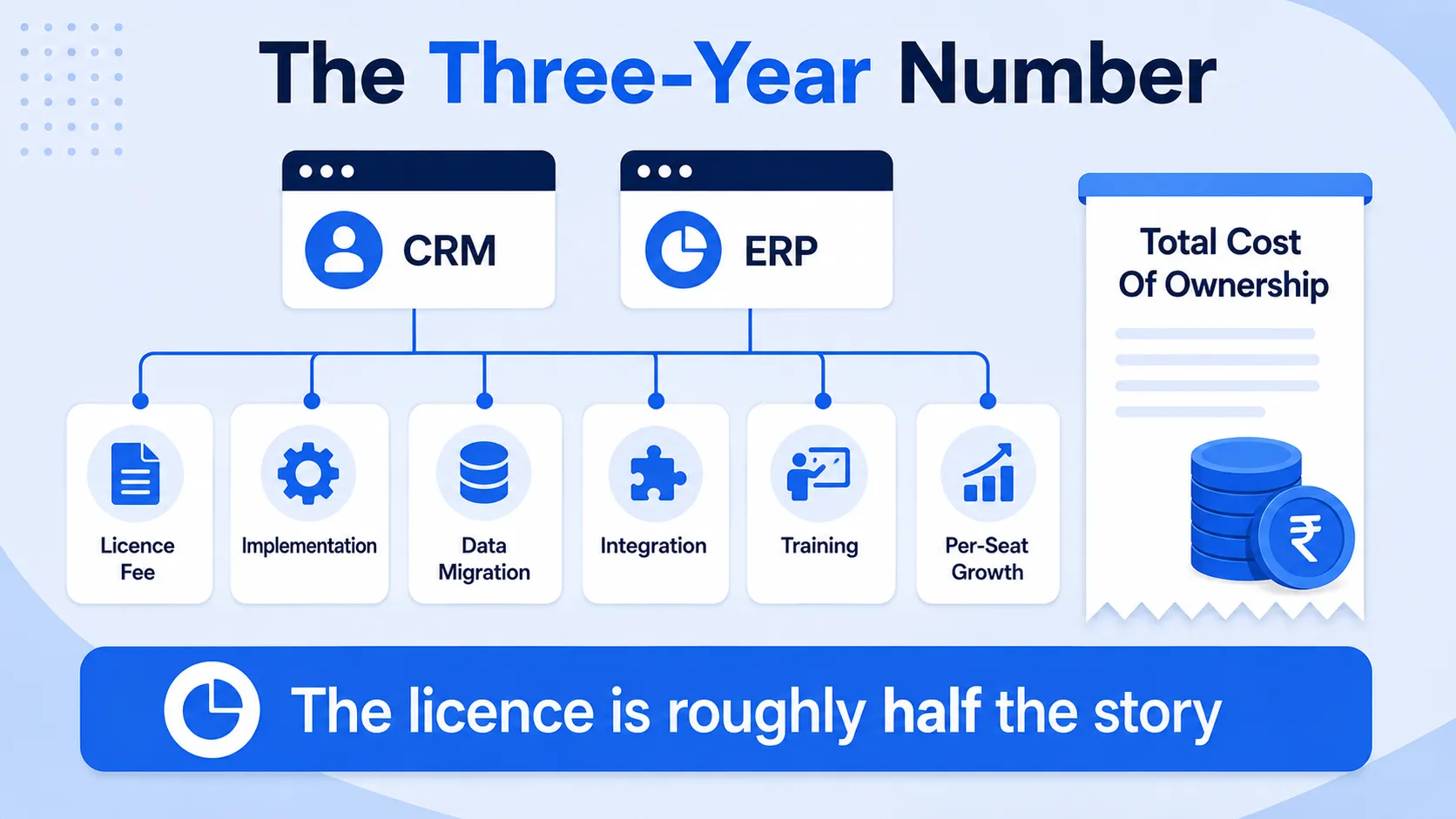
The lines nobody quotes you
Implementation
Configuration, workflows, permissions, reports. For a straightforward CRM this is weeks. For an ERP touching finance and inventory it is months, and it is the line most likely to be underestimated in the sales conversation.
Data migration
Getting your existing customers, products and history in. Always longer than estimated, because the data is messier than anyone remembers. This is where projects slip.
Integration
Connecting to accounting, your website, your payment gateway, your messaging. Each integration is its own small project, and a vendor calling an integration supported often means an API exists rather than that it works out of the box.
Training and lost productivity
Not the demo. The weeks where people are slower because they are learning, plus the ongoing cost of onboarding every new hire onto the system.
Per-seat growth
Priced per user, so cost scales with hiring. Model it at your headcount in three years, not today, because that is the number you will actually pay.
The tier upgrade
Many products place one feature you will inevitably need in a higher tier. Check which tier your must-have features are actually in before comparing headline prices.
A three-year model
Take a mid-tier CRM at Rs 2,000 per user per month for fifteen users.
The licence alone is Rs 3.6 lakh a year, or Rs 10.8 lakh over three years, before any price increase and before any headcount growth. Add implementation and migration as a one-time cost, two integrations each with their own build and maintenance, and the training and lost productivity of the first month.
By the time those are counted, the licence is roughly half the story. If you evaluated purely on the monthly price, you evaluated half the decision, and the half you skipped is the half that varies most between vendors.
The same exercise on an ERP produces a starker result, because implementation on a system touching finance and inventory is measured in months rather than weeks. For ERP the licence is often the minority of the three-year cost by a considerable margin.
Where the money is genuinely wasted
- Buying more product than you need. Enterprise tiers bought during evaluation and never reassessed, in a market where 25% to 30% of software licences go unused.
- Paying for seats that left. Offboarding processes that remove the email account but not the CRM licence.
- Customising instead of adapting. Every customisation is a maintenance liability and an upgrade blocker, and should be reserved for the process that genuinely differentiates you.
- Two systems doing one job. A CRM plus a separate pipeline tracker because sales did not like the CRM, so now data lives in both and neither is trusted.
- Modules bought for a plan that changed. Paid annually, used never.
The question that decides it
How much of your process is genuinely yours?
If the answer is not much, buy a product, adapt your process to it, and spend the saved money on something that differentiates you. Standard products are cheaper, faster to deploy and maintained by somebody else, and the discipline of adapting to a well-designed default is usually good for the business anyway.
If the answer is a lot, a product will need enough customisation that you end up paying subscription fees for something you have half-rebuilt. That is the point at which custom becomes reasonable, and the comparison should be honest about maintenance cost on the custom side too rather than pretending it is a one-time expense.
Most businesses land somewhere in between, and the best answer is usually a standard product for the standard functions with a custom piece for the one process that is genuinely theirs, connected by an integration layer.
From our own projects
We have built the full billing and document stack on client systems, covering proforma invoice, quotation, delivery challan, purchase order, purchase invoice, tax invoice, credit note and debit note, with role-based access separating superadmin from employee.
What that experience says about total cost is straightforward: the build is the small number. Tax rules change, document formats change, statutory requirements change, and the three-year cost is dominated by who keeps the system correct as those change. That is true whether you buy or build, and it is the question worth asking a vendor before signing.
Frequently asked questions
Weighing a CRM decision?
We build custom CRM and billing systems, and we will tell you when a standard product is the better answer for your situation.